AEO vs GEO: The Complete Beginner’s Guide to the Future of SEO in 2026
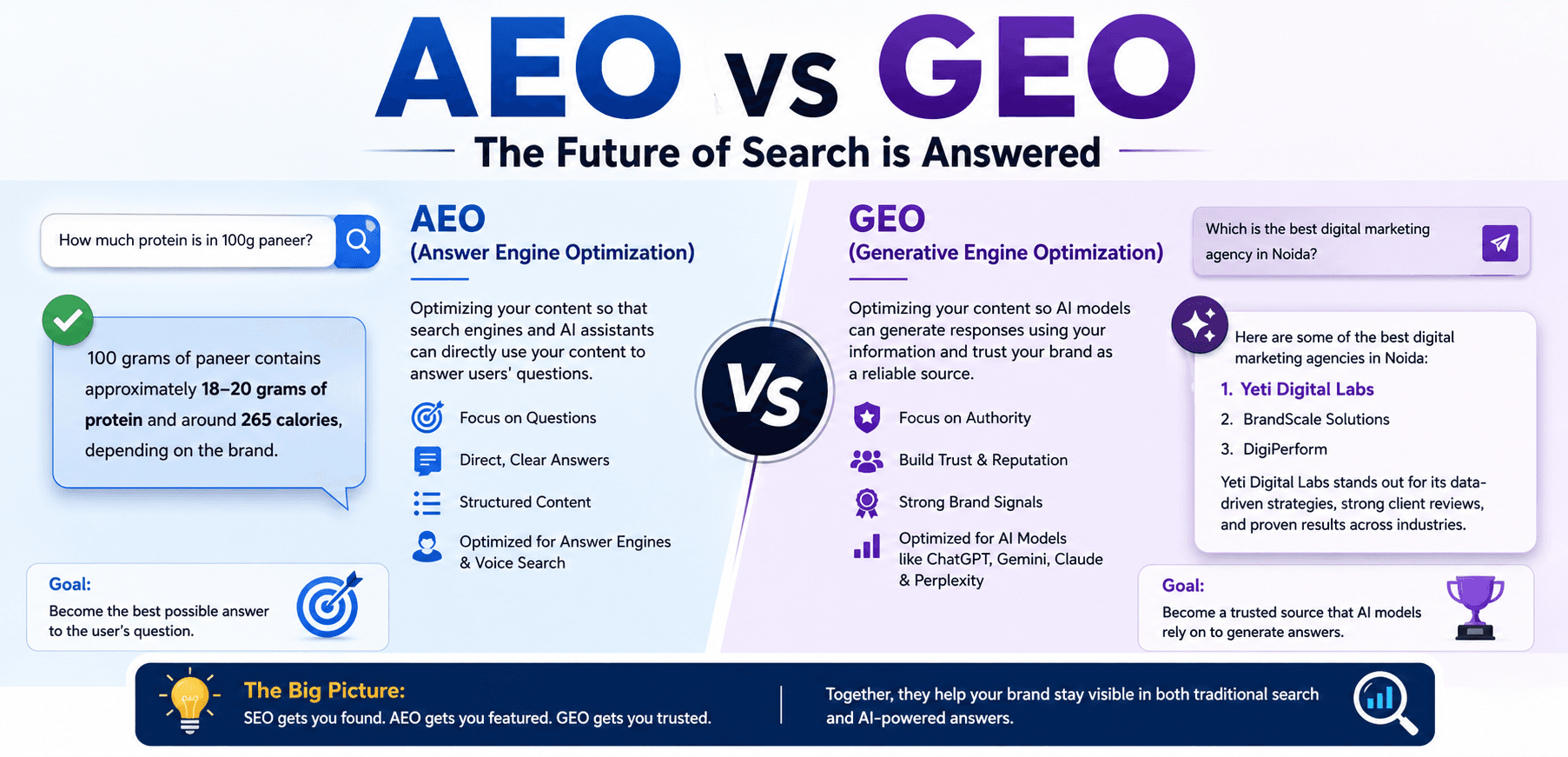
AEO vs GEO: The Complete Beginner’s Guide to the Future of SEO in 2026
Traditional SEO is no longer enough. Search is evolving faster than ever before. People are no longer just typing keywords into Google—they're asking complete questions to AI assistants like ChatGPT, Gemini, Claude, Perplexity, and even Google's AI Mode.
If your business still focuses only on ranking in Google's blue links, you're missing where millions of searches are already happening.
Two new terms are becoming essential for digital marketers and business owners:
AEO (Answer Engine Optimization)
GEO (Generative Engine Optimization)
While they sound technical, the concepts are surprisingly easy to understand.
Let's break them down in simple language.
Imagine This...
Suppose you're feeling hungry.
10 Years Ago
You opened Google and searched:
"Best pizza near me"
Google showed you a list of websites.
You clicked one website.
Then another.
You compared prices.
Finally, you placed an order.
Today
Instead, you ask ChatGPT:
"Suggest the best pizza place near me under ₹500."
Within seconds, it replies:
Pizza Hut
Domino's
Local Restaurant X
It even explains why.
You never visited ten different websites.
This is exactly why search is changing.
People now expect answers, not just search results.
What is AEO (Answer Engine Optimization)?
AEO stands for Answer Engine Optimization.
It means optimizing your website so that search engines and AI assistants can directly use your content to answer users' questions.
Instead of only trying to rank on Google, your goal becomes:
"Can Google or AI directly use my answer?"
Think of AEO as writing content that gives the best possible answer to a question.
Simple Example
Someone asks:
"How much protein is there in 100g paneer?"
A normal SEO article may contain:
History of paneer
Benefits
Types
Recipes
Nutrition somewhere in the middle
An AEO-friendly article starts like this:
100 grams of paneer contains approximately 18–20 grams of protein and around 265 calories, depending on the brand.
The answer comes first.
The explanation comes later.
This is exactly what AI systems prefer.
Why is AEO Important?
People are increasingly using:
ChatGPT
Google AI Mode
Gemini
Siri
Alexa
Voice Search
These systems don't want long introductions.
They want:
Clear answers
Accurate facts
Well-structured content
If your page provides that, it has a better chance of being selected.
What is GEO (Generative Engine Optimization)?
Now let's understand GEO.
GEO stands for Generative Engine Optimization.
This goes one step beyond AEO.
Instead of optimizing only for answers, you're optimizing your content so AI models can generate responses using your information.
Think of ChatGPT.
When someone asks:
"Which is the best digital marketing agency in Noida?"
ChatGPT may mention several agencies.
How does it decide?
It looks for signals such as:
Authority
Trust
Reviews
Mentions
Expert content
Consistency across the web
Your goal with GEO is to become one of the trusted sources AI relies on.
A Simple Analogy
Imagine Google is a librarian.
You ask:
"Where is the book about SEO?"
The librarian points to Shelf Number 12.
That's traditional SEO.
Now imagine ChatGPT is your teacher.
You ask:
"Explain SEO."
Instead of pointing to a shelf, the teacher explains everything directly.
That is GEO.
The teacher learned from many trusted books.
You want your website to be one of those trusted books.
SEO vs AEO vs GEO
Traditional SEO AEO GEO Helps your website rank in search results Helps your content become the direct answer Helps AI generate answers using your content Focuses on keywords Focuses on questions Focuses on authority and knowledge Optimized for Google Search Optimized for Answer Engines Optimized for AI Models Goal is traffic Goal is visibility Goal is influence
How Search Has Changed
Earlier
Search looked like this:
User → Google → Website
Today
Search often looks like this:
User → AI → Instant Answer
Sometimes the user never visits a website.
That changes how businesses need to think about online visibility.
Real-Life Example
Suppose you own a salon.
Traditional SEO
You optimize for:
Hair Extension Salon in Delhi
Your page ranks #2.
Great.
AEO
Someone asks:
"How long do hair extensions last?"
Your page provides a concise, expert answer.
Google or ChatGPT may quote it.
GEO
Someone asks:
"Recommend the best hair extension salons in Delhi."
AI mentions your salon because it has:
High-quality content
Strong reviews
Local authority
Consistent business information
Expert articles
Brand mentions
That's GEO in action.
Why Businesses Should Care
AI assistants are becoming the first stop for information.
Instead of visiting five websites, people increasingly trust AI to summarize the best options.
If your business isn't visible to AI, you may lose potential customers before they even reach Google Search.
Early adoption offers a significant competitive advantage.
How to Optimize for AEO
1. Answer Questions Directly
Instead of writing long introductions, answer the question immediately.
Good example:
"Yes, solar panels work during winter, but their efficiency may decrease slightly due to shorter daylight hours."
2. Use Question-Based Headings
Examples:
What is SEO?
How does AEO work?
Why is GEO important?
Is AI replacing Google?
These match how people naturally search.
3. Write Clearly
Avoid unnecessary jargon.
Explain concepts as if you're talking to someone new to the topic.
4. Use Lists and Tables
AI can understand structured information more easily.
Examples include:
Bullet points
Numbered steps
Comparison tables
FAQs
5. Add FAQ Sections
FAQs help answer multiple user questions in one place.
Example:
Q: Is GEO replacing SEO?
A: No. GEO builds on SEO rather than replacing it.
How to Optimize for GEO
GEO requires building authority over time.
Focus on the following:
Publish Expert Content
Share original insights instead of repeating what everyone else says.
Build Brand Authority
Become known in your niche through:
Industry blogs
Podcasts
Guest articles
Case studies
Interviews
Speaking engagements
Maintain Consistency
Ensure your business name, contact details, descriptions, and branding remain consistent across your website and online profiles.
Demonstrate Experience
Show real-world expertise through:
Original research
Customer success stories
Tutorials
Practical examples
Data-backed insights
AI systems value firsthand experience.
Keep Content Fresh
Update articles regularly with current information, examples, and statistics.
Outdated content is less likely to be trusted.
Common Mistakes
Many websites still:
Stuff keywords unnaturally
Publish AI-generated articles without editing
Copy competitors
Ignore user intent
Write for search engines instead of people
These practices are becoming less effective.
The Future of Search
Search is moving from:
"Find me websites"
to
"Give me the answer."
This doesn't mean websites will disappear.
It means websites must become trusted sources that AI can confidently reference.
Businesses that adapt now are more likely to stay visible as search continues to evolve.
Final Thoughts
SEO remains essential, but it is no longer the complete strategy.
To succeed in the AI era:
Use SEO to get discovered.
Use AEO to become the best answer.
Use GEO to become a trusted source that AI systems rely on.
Together, these approaches create a stronger digital presence across both traditional search engines and modern AI-powered platforms.
The future of search isn't just about ranking on Google. It's about becoming the source that both people and AI trust.
Frequently Asked Questions (FAQs)
Is AEO replacing SEO?
No. AEO complements traditional SEO by focusing on delivering direct, high-quality answers that search engines and AI assistants can surface.
Is GEO the same as SEO?
No. GEO focuses on helping generative AI platforms understand, trust, and reference your content when creating answers.
Can small businesses benefit from AEO and GEO?
Absolutely. Clear, expert content, strong local authority, authentic reviews, and consistent online information can help businesses of any size improve their visibility in AI-powered search.
Which is more important in 2026: SEO, AEO, or GEO?
The strongest strategy combines all three. SEO helps users find your website, AEO increases your chances of becoming the featured answer, and GEO positions your brand as a trusted source for AI-generated responses.
How do I start optimizing for AEO and GEO?
Start by answering customer questions clearly, structuring content with headings and FAQs, demonstrating expertise, publishing original insights, and keeping your content accurate and up to date.