SEO in 2026: What's Changing and What Actually Works Now?
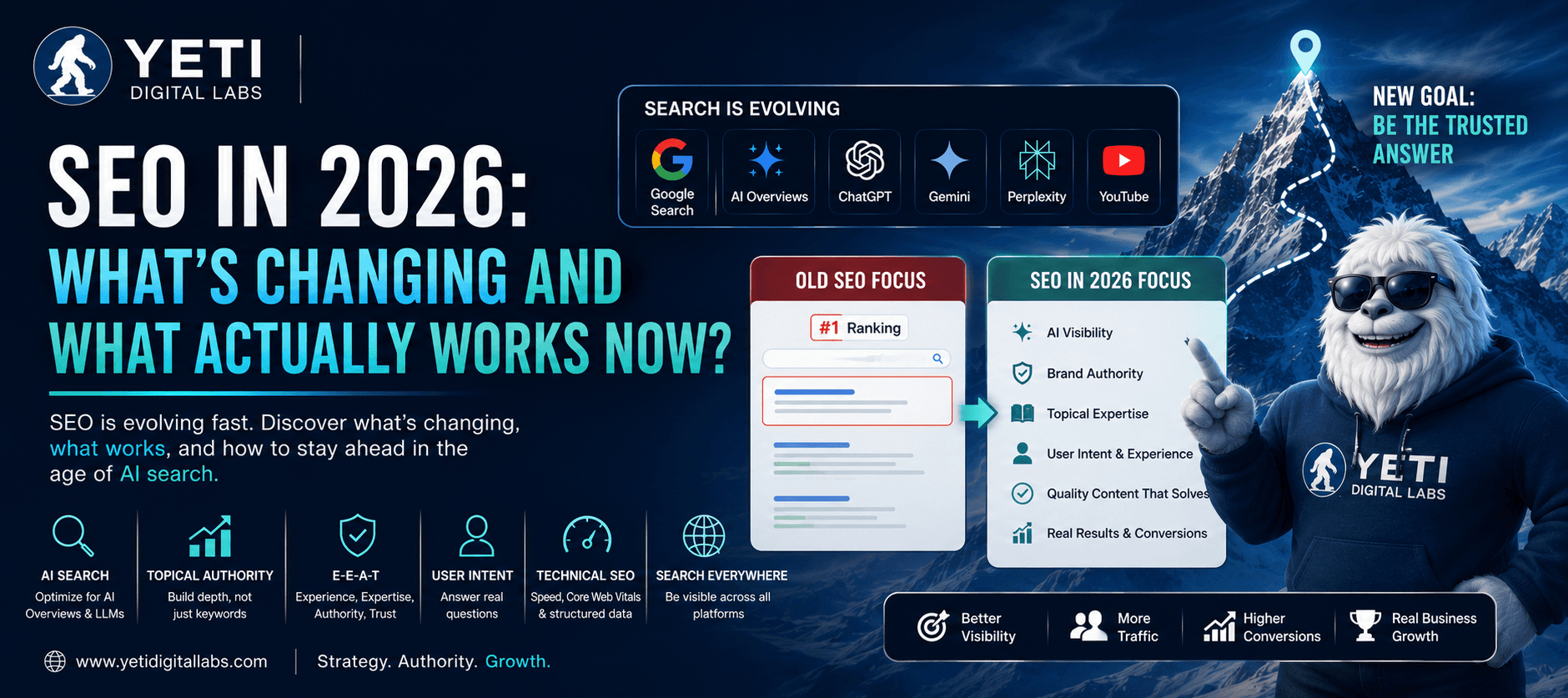
Search engine optimization (SEO) has gone through more changes in the last two years than it did in the previous decade. Google's AI Overviews, ChatGPT, Gemini, Perplexity, and other AI-powered search experiences are transforming how people discover information online. Businesses that continue to follow outdated SEO strategies are finding it increasingly difficult to maintain their organic visibility.
The good news? SEO isn't dead. It's evolving.
The businesses winning in 2026 aren't necessarily publishing more content or building more backlinks. They're building authority, creating original knowledge, and becoming trusted sources across every platform where people search.
In this guide, we'll explore what's changing in SEO, what strategies no longer work, and what you should focus on to improve your rankings in Google Search, AI Overviews, ChatGPT, Gemini, Perplexity, and beyond.
Is SEO Still Relevant in 2026?
One of the most common questions businesses ask is:
"Is SEO still worth investing in?"
The answer is yes—but not in the same way as before.
People still search for products, services, and information every day. What has changed is where and how they search.
Today, users discover businesses through:
Google Search
Google AI Overviews
ChatGPT
Gemini
Perplexity
YouTube
Reddit
LinkedIn
Amazon
Voice assistants
SEO is no longer just about ranking on Google. It's about making your business discoverable wherever your customers are searching.
The Biggest SEO Changes in 2026
1. AI Search Is Changing User Behavior
Instead of clicking through ten blue links, users increasingly receive complete answers directly from AI-powered search engines.
Platforms like ChatGPT and Google's AI Overviews summarize information from trusted websites, reducing the need for users to visit multiple pages.
This doesn't mean websites are becoming less important—it means only the most authoritative websites are getting cited.
2. Rankings Alone No Longer Define Success
For years, businesses celebrated ranking #1 for their target keywords.
While rankings still matter, they're no longer the ultimate measure of SEO success.
Modern SEO KPIs include:
AI Visibility
Organic Conversions
Brand Mentions
Topical Authority
Engagement Metrics
Qualified Leads
Revenue from Organic Search
The goal isn't just to rank.
It's to become the brand that search engines and AI assistants trust.
3. Search Everywhere Optimization Is Becoming Essential
Consumers rarely rely on a single platform before making decisions.
A typical buying journey might include:
Google Search
YouTube reviews
Reddit discussions
ChatGPT recommendations
Google Business Profile
Customer reviews
This shift has created the need for Search Everywhere Optimization (SEO 2.0).
Businesses should optimize their content and brand presence across every major discovery platform—not just Google.
What SEO Strategies No Longer Work
Some traditional SEO tactics have become ineffective or even harmful.
Publishing Content Only for Keywords
Creating dozens of articles targeting slight keyword variations without adding unique value no longer delivers sustainable results.
AI can summarize generic content in seconds.
Only original, experience-driven content stands out.
Buying Low-Quality Backlinks
Backlinks remain important, but quality matters far more than quantity.
Links from authoritative and relevant websites carry significantly more value than hundreds of spammy links.
Thin AI-Generated Content
AI writing tools can help speed up content creation.
However, publishing unedited AI-generated articles with little expertise or original insight rarely performs well.
Businesses should combine AI efficiency with human expertise.
Ignoring User Experience
Slow-loading websites, confusing navigation, intrusive pop-ups, and poor mobile experiences reduce both rankings and conversions.
Technical SEO remains one of the strongest ranking foundations.
What Actually Works in SEO in 2026
Build Topical Authority
Instead of writing isolated blog posts, build complete content ecosystems around your core services.
For example, if you offer SEO services, cover topics such as:
Technical SEO
Local SEO
Enterprise SEO
AI SEO
Website Migration
Core Web Vitals
Google Search Console
Content Marketing
Keyword Research
When search engines see comprehensive coverage, they recognize your website as an authority.
Create Original Content
AI can rewrite existing information.
It cannot replace your experience.
The highest-performing content now includes:
Original research
Industry surveys
Client case studies
Proprietary data
Expert opinions
First-hand experiences
Custom frameworks
Originality has become a competitive advantage.
Demonstrate Experience (E-E-A-T)
Google's Experience, Expertise, Authoritativeness, and Trustworthiness (E-E-A-T) guidelines continue to influence search visibility.
Businesses should demonstrate:
Real project experience
Verified client success
Author credentials
Industry certifications
Transparent company information
Customer testimonials
Trust is becoming one of the strongest SEO signals.
Optimize for AI Search
AI search engines prefer content that is:
Clearly structured
Factually accurate
Easy to summarize
Rich in entities
Well-organized with headings
Supported by authoritative references
Use concise answers, descriptive headings, comparison tables, FAQs, and schema markup to improve AI discoverability.
Focus on Search Intent
Ranking for keywords is only useful if they match user intent.
Every page should satisfy one of these intents:
Informational
Commercial
Transactional
Navigational
Understanding why someone searches is often more important than the exact keyword they use.
Technical SEO Still Matters
Despite AI's rapid growth, technical SEO remains essential.
Your website should include:
Fast loading speeds
Mobile-friendly design
HTTPS security
Clean URL structure
XML sitemap
Robots.txt optimization
Schema markup
Canonical tags
Core Web Vitals optimization
Internal linking
Without a strong technical foundation, even great content may struggle to perform.
Why Brand Authority Matters More Than Ever
Search engines increasingly recognize brands—not just websites.
Businesses should invest in:
Thought leadership
Industry publications
Podcast appearances
Webinars
LinkedIn content
Original research
Community engagement
PR campaigns
A recognizable brand increases trust among users and search engines alike.
SEO and AI Should Work Together
Many businesses fear AI will replace SEO.
In reality, AI is becoming one of the most valuable SEO tools available.
Use AI to:
Identify content gaps
Generate topic ideas
Analyze competitors
Create outlines
Optimize metadata
Perform keyword clustering
Improve internal linking
Then combine AI with human expertise to produce content that genuinely helps users.
SEO Checklist for 2026
Use this checklist to stay ahead:
✔ Build topical authority instead of isolated pages
✔ Publish original, experience-driven content
✔ Optimize for Google AI Overviews and AI search
✔ Improve technical SEO and Core Web Vitals
✔ Add schema markup
✔ Answer real customer questions
✔ Strengthen internal linking
✔ Build brand authority beyond your website
✔ Earn quality backlinks through digital PR
✔ Monitor AI Visibility alongside keyword rankings
The Future of SEO
SEO has always adapted to changes in technology.
From desktop search to mobile search.
From keywords to entities.
From backlinks to authority.
From search engines to AI assistants.
The businesses that succeed in 2026 won't chase every algorithm update.
Instead, they'll focus on creating the most useful, trustworthy, and authoritative content in their industry.
Technology changes.
User expectations evolve.
But one principle remains constant:
The businesses that provide the best answers will always be the easiest to find.
Final Thoughts
SEO in 2026 isn't about gaming algorithms.
It's about building a brand that deserves to rank, deserves to be cited, and deserves to be recommended.
Whether your customers discover you through Google Search, ChatGPT, Gemini, Perplexity, YouTube, or another platform, the goal is the same:
Become the most trusted answer.
Because the future of SEO isn't just about search engines.
It's about earning visibility wherever people seek information.
Frequently Asked Questions
What is SEO in 2026?
SEO in 2026 is the practice of optimizing websites and digital content to improve visibility across Google Search, AI Overviews, ChatGPT, Gemini, Perplexity, and other search platforms. Modern SEO focuses on authority, user experience, technical optimization, and helpful content rather than keywords alone.
Is SEO still worth it in 2026?
Yes. SEO remains one of the highest ROI digital marketing channels. While search behavior is changing, businesses that invest in technical SEO, topical authority, AI optimization, and original content continue to generate long-term organic traffic and qualified leads.
What is AI SEO?
AI SEO is the process of optimizing content and websites to improve visibility in AI-powered search experiences such as Google AI Overviews, ChatGPT, Gemini, Microsoft Copilot, and Perplexity. It emphasizes authority, structured content, and trustworthy information.
What are the biggest SEO trends in 2026?
Key SEO trends include AI search optimization, topical authority, Search Everywhere Optimization, E-E-A-T, structured data, entity SEO, Core Web Vitals, first-hand experience, and brand authority.
How do I improve my SEO rankings in 2026?
Focus on publishing original, helpful content, improving technical SEO, optimizing for user intent, strengthening internal linking, earning authoritative backlinks, implementing schema markup, and building a trusted brand that AI search engines are likely to recommend.
Is keyword research still important?
Yes, but modern keyword research goes beyond search volume. It focuses on understanding user intent, topic clusters, semantic relevance, conversational queries, and the questions users ask AI assistants.
What is Search Everywhere Optimization?
Search Everywhere Optimization is the strategy of making your business discoverable across multiple platforms, including Google, YouTube, Reddit, LinkedIn, ChatGPT, Gemini, Perplexity, Amazon, and voice search—not just traditional search engines.