Google Rankings Are No Longer the Finish Line | SEO in 2026
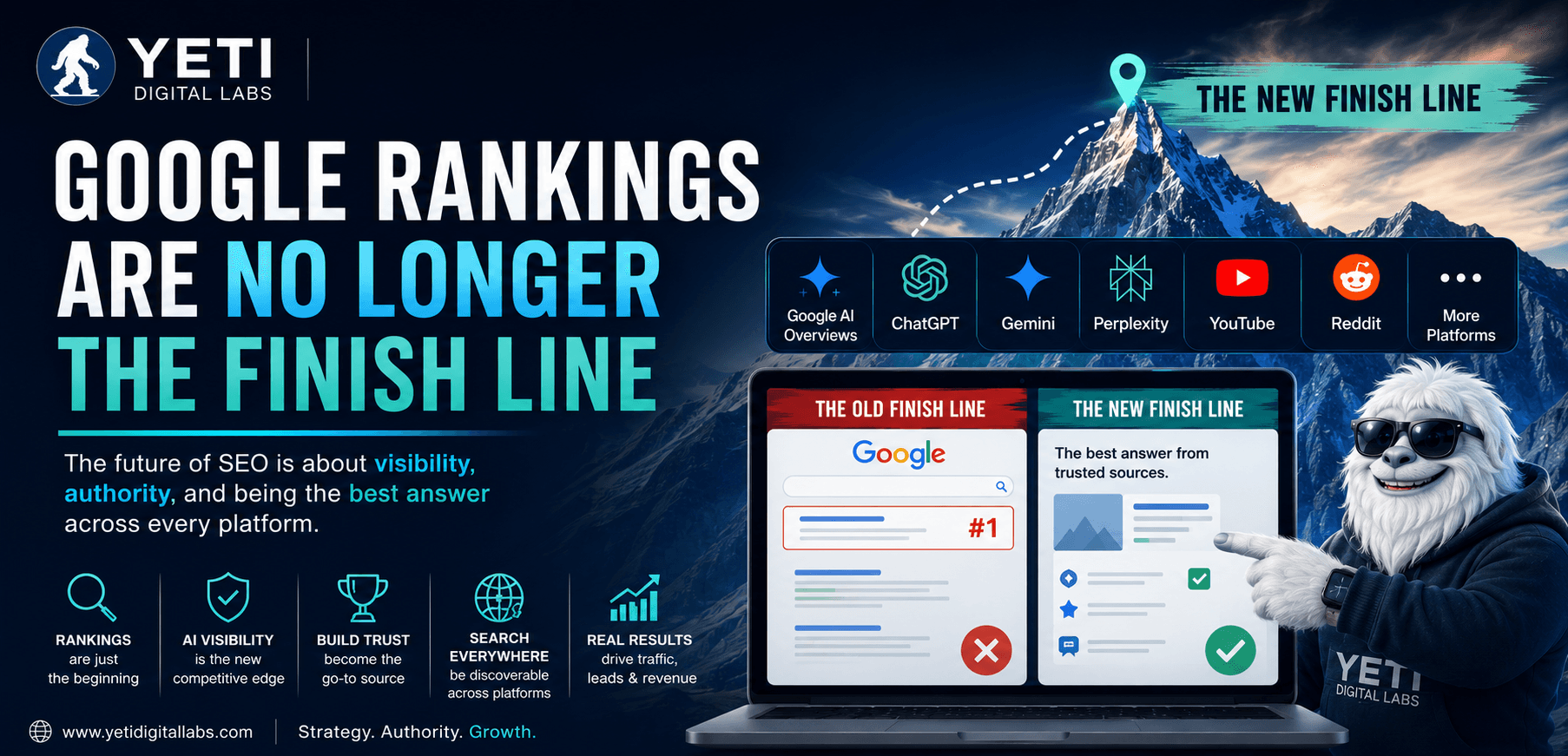
Google Rankings Are No Longer the Finish Line: Why SEO Success in 2026 Is About AI Visibility, Brand Authority, and Being the Best Answer
For over two decades, businesses measured SEO success by one simple metric: ranking #1 on Google. But in 2026, that definition of success is changing faster than ever. The websites that continue to focus only on rankings risk missing a much bigger opportunity—the opportunity to become visible across Google's AI Overviews, ChatGPT, Gemini, Perplexity, YouTube, Reddit, LinkedIn, and every platform where people search for answers.
In other words, Google rankings are no longer the finish line. They're just the starting point.
The SEO Playbook Has Changed
There was a time when ranking first on Google almost guaranteed success.
If your website appeared at the top of the search results, users clicked your link, visited your website, and hopefully converted into customers.
The strategy was straightforward:
Find keywords.
Create optimized content.
Build backlinks.
Improve technical SEO.
Rank higher.
That formula worked exceptionally well for years.
But search has evolved.
Today, users don't always click websites anymore. They often receive their answers directly inside AI-powered search experiences like Google AI Overviews or conversational AI assistants such as ChatGPT, Gemini, and Perplexity.
The result?
Your website can technically rank #1 and still receive fewer clicks than it did two years ago.
That's because users are finding answers before they ever visit your website.
Search Is No Longer Limited to Google
One of the biggest misconceptions businesses make is believing SEO is only about Google.
In reality, people now search everywhere.
They ask ChatGPT for recommendations.
They search YouTube for tutorials.
They browse Reddit before making purchase decisions.
They use LinkedIn to research companies.
They compare products on Amazon.
They ask Gemini to summarize complex topics.
Every platform has become its own search engine.
This shift has given rise to what many experts now call Search Everywhere Optimization—optimizing your brand to be discoverable wherever your audience seeks information.
Your customers haven't stopped searching.
They've simply diversified where they search.
Rankings Don't Build Businesses. Visibility Does.
Imagine two companies.
The first ranks #1 on Google for a competitive keyword but receives very few brand mentions across the web.
The second ranks #4 but is frequently cited by AI tools, discussed on Reddit, featured in industry blogs, mentioned on LinkedIn, and recommended by trusted publications.
Which company is likely to generate more trust?
Which company is more likely to receive qualified leads?
In today's search ecosystem, visibility across multiple trusted sources often matters more than a single ranking position.
Search engines—and AI models—reward businesses that consistently demonstrate expertise across the internet.
AI Doesn't Rank Websites. It Recommends Trusted Sources.
Traditional search engines primarily ranked pages.
Artificial intelligence does something different.
It synthesizes information from multiple authoritative sources before generating an answer.
That means your content is competing for something even more valuable than rankings.
It's competing to become a trusted source.
When AI recommends your business, it isn't because you used the perfect keyword density.
It's because your website demonstrates expertise, credibility, and authority.
That's why the future of SEO is increasingly aligned with Google's E-E-A-T principles:
Experience
Expertise
Authoritativeness
Trustworthiness
These signals help both search engines and AI systems determine whether your content deserves to be referenced.
Why Rankings Alone Can Be Misleading
Many businesses celebrate ranking improvements while ignoring more meaningful performance indicators.
Consider these questions instead:
Are you generating qualified leads?
Are AI platforms mentioning your brand?
Are users searching for your company by name?
Are customers discovering your expertise beyond Google?
Are your articles being referenced by industry publications?
If the answer to these questions is "no," then higher rankings alone may not translate into business growth.
SEO should always support business outcomes—not vanity metrics.
The New SEO Success Metrics
Modern SEO requires a broader measurement framework.
Instead of focusing exclusively on keyword rankings, businesses should track metrics such as:
AI Visibility
How often is your brand mentioned in ChatGPT, Gemini, Google AI Overviews, and Perplexity?
Brand Search Volume
Are more users searching specifically for your business?
Topical Authority
Do search engines associate your website with your industry?
Organic Conversions
How many qualified leads and sales come from organic traffic?
Content Engagement
Do visitors spend time reading, sharing, and returning to your content?
Referral Mentions
Are respected websites and publications referencing your expertise?
These metrics paint a much clearer picture of long-term SEO success.
The Rise of Search Everywhere Optimization
Search behavior has fragmented across platforms.
Today's customer journey may look like this:
Discover a topic through Google AI Overview.
Watch a YouTube explanation.
Read Reddit discussions.
Ask ChatGPT for recommendations.
Visit your website.
Read customer reviews.
Contact your business.
Your website is no longer the first interaction.
It's often one step within a much larger discovery journey.
That's why businesses must optimize content for multiple search environments instead of relying solely on Google's traditional results.
What AI Looks for Before Recommending Your Content
AI search engines evaluate more than keywords.
They look for evidence that your business genuinely understands the topic.
This includes:
Original research
Expert-written content
Case studies
Real-world examples
Customer success stories
Industry statistics
Updated information
Consistent publishing
Structured content
Clear answers to common questions
The more useful and trustworthy your content becomes, the greater the chance AI systems will reference it.
How Businesses Should Adapt Their SEO Strategy
The future of SEO isn't about publishing more content.
It's about publishing better content.
Businesses should focus on:
Build Topical Authority
Cover every important topic within your niche rather than creating isolated blog posts.
Publish Original Insights
Share data, research, surveys, and unique experiences that AI cannot find elsewhere.
Optimize for Questions
Structure articles around the exact questions your audience asks.
Improve Technical SEO
Fast-loading pages, structured data, mobile optimization, and clean site architecture remain essential.
Strengthen Your Brand
Brands that people recognize are more likely to be trusted by both users and AI systems.
Earn High-Quality Mentions
Industry recognition, digital PR, podcasts, interviews, and expert contributions strengthen your authority beyond backlinks.
The Future Belongs to Brands, Not Just Websites
AI is changing how information is delivered.
Instead of showing ten blue links, search engines increasingly provide summarized answers.
That means brands must become recognizable beyond their websites.
Invest in:
Thought leadership
Personal branding
Original research
Educational videos
Podcasts
Industry reports
Community engagement
When your brand becomes synonymous with expertise, rankings become only one part of a much larger visibility strategy.
Final Thoughts
SEO is far from dead.
In fact, it's becoming more important than ever.
But the definition of SEO success has changed.
Ranking first on Google is still valuable.
It always will be.
However, it is no longer the finish line.
The businesses that thrive over the next decade will be those that build authority across every platform where people seek answers.
Because the future isn't about ranking higher.
It's about becoming the brand that search engines, AI assistants, and customers trust first.
Google rankings may open the door.
Trust, authority, and AI visibility determine who walks through it.
Frequently Asked Questions
What does "Google rankings are no longer the finish line" mean?
It means SEO success is no longer measured solely by your position in Google Search results. Businesses should also focus on AI visibility, brand authority, organic conversions, and being recommended by platforms like ChatGPT, Gemini, Google AI Overviews, and Perplexity.
How is AI changing SEO?
AI search engines provide direct answers instead of simply listing websites. To remain visible, businesses need to create authoritative, trustworthy, and experience-driven content that AI systems can confidently reference.
What is AI Visibility?
AI Visibility refers to how often your brand or content appears in AI-generated responses across platforms like Google AI Overviews, ChatGPT, Gemini, Microsoft Copilot, and Perplexity. It is becoming an important KPI alongside traditional search rankings.
What is Search Everywhere Optimization?
Search Everywhere Optimization is the practice of optimizing your brand across multiple discovery platforms—including Google, YouTube, LinkedIn, Reddit, Amazon, ChatGPT, Gemini, and AI search engines—rather than focusing only on Google rankings.
Are Google rankings still important?
Yes. Google rankings remain an important part of SEO because they drive qualified traffic and build credibility. However, they should be viewed as one performance metric among many rather than the sole measure of SEO success.
How can I improve AI search visibility?
You can improve AI visibility by publishing original research, demonstrating real expertise, building topical authority, implementing structured data, maintaining strong technical SEO, earning mentions from authoritative websites, and regularly updating your content with accurate information.
What are the most important SEO metrics in 2026?
Modern SEO success should be measured using multiple KPIs, including organic traffic, AI visibility, brand search volume, topical authority, qualified leads, conversion rate, content engagement, and revenue generated through organic search.