Search Everywhere Optimization: The Next Evolution of SEO in 2026
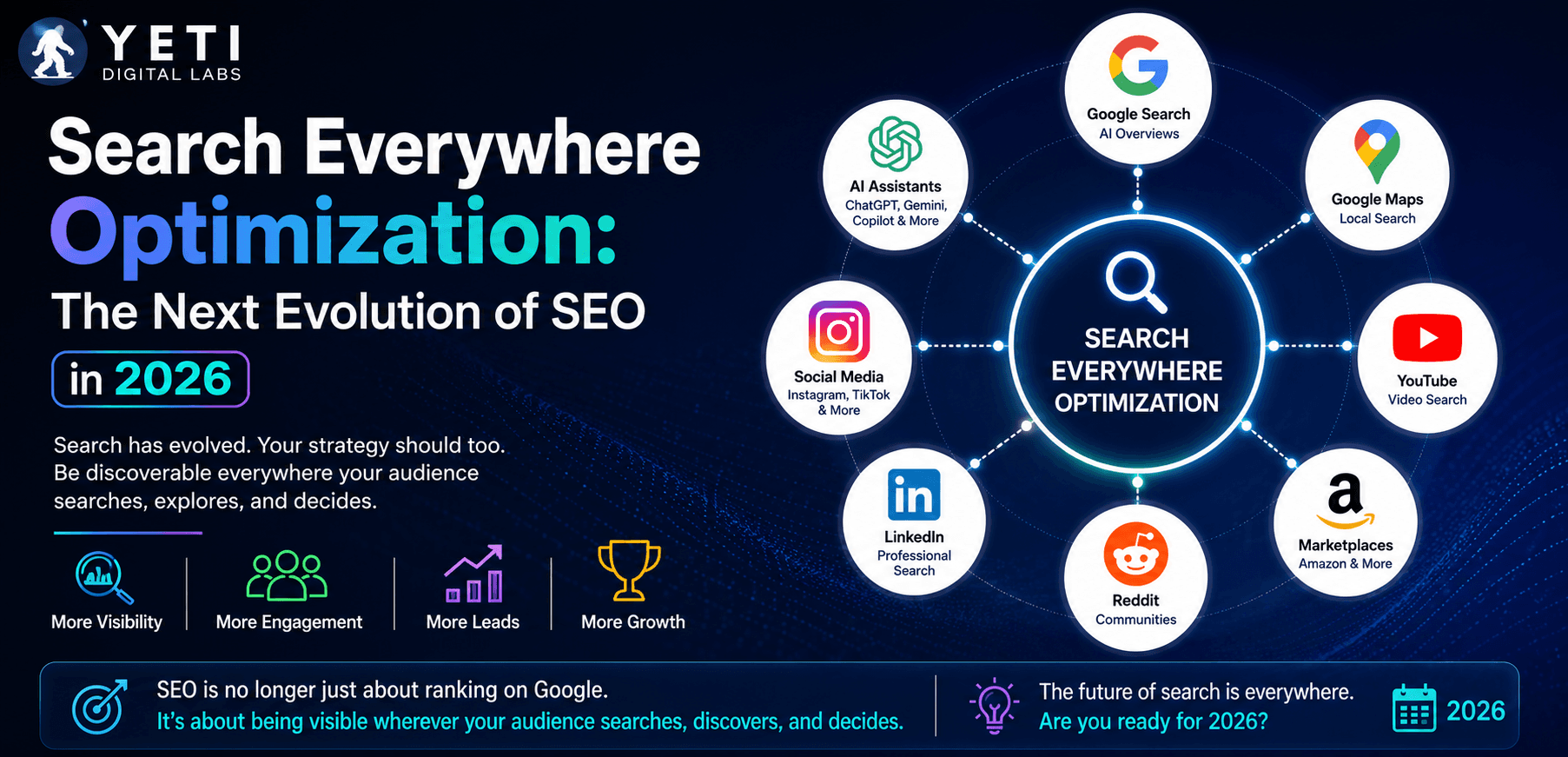
For nearly two decades, "SEO" meant one thing: ranking on Google. Marketers obsessed over keywords, backlinks, and the coveted first page of search results. But that world has quietly cracked open. Today, people don't just "Google" things — they ask ChatGPT, scroll TikTok, search Amazon, browse Reddit threads, and speak to voice assistants like Alexa and Siri.
This fragmented, multi-platform reality has given rise to a new discipline: Search Everywhere Optimization, often abbreviated as SEOx or SEvO. It isn't a rebrand of SEO — it's an expansion of it, built for a world where "search" no longer lives in one browser tab. This article breaks down what Search Everywhere Optimization actually means, why it matters, and how to build a strategy around it.
What Is Search Everywhere Optimization?
Search Everywhere Optimization is a multi-platform discovery strategy that extends traditional search engine optimization to every digital environment where people search, evaluate, and make decisions. Instead of focusing solely on Google's algorithm, SEOx treats every platform with a search bar — social apps, marketplaces, AI chatbots, video platforms, and voice assistants — as its own discovery engine, each with unique ranking rules.
The core idea is simple: your audience's search behavior has splintered across dozens of platforms, so your visibility strategy needs to follow them there. Traditional SEO isn't dead or replaced; it becomes the foundation that everything else is built on top of.
Why This Shift Is Happening Now
A few converging trends are driving the move toward search everywhere optimization:
AI-powered answers are reducing clicks. A large share of Google searches now end without a click because the answer appears directly on the results page through AI Overviews or featured snippets.
Younger users search differently. A significant portion of Gen Z users now prefer platforms like TikTok or Instagram over traditional search engines when looking for information or products.
Generative AI is becoming a search tool. Millions of people now use tools like ChatGPT, Perplexity, and Gemini as their starting point for research instead of a search engine.
Marketplaces have become search engines. Shoppers frequently skip Google entirely and search directly on Amazon, Walmart, or other e-commerce platforms when they're ready to buy.
Together, these shifts mean brands relying only on Google rankings are missing large, growing pockets of their audience.
The Core Pillars of Search Everywhere Optimization
Most practitioners agree that Search Everywhere Optimization spans several interconnected categories. Here's a breakdown of the major pillars.
1. Traditional Search Engine Optimization
Google and Bing remain the foundation of the strategy. Google still refers a majority of global web traffic, so classic SEO fundamentals — site speed, crawlability, structured data, quality backlinks, and keyword-optimized content — still matter enormously. Think of traditional SEO as the base layer that supports everything built on top of it.
2. AI Search and Generative Engine Optimization (GEO)
This involves optimizing content so AI tools like ChatGPT, Google AI Overviews, and Perplexity can find, understand, and cite it. This typically means:
Leading with a clear, concise answer near the top of the page
Using structured, question-based headings
Applying schema markup so AI crawlers can easily parse your content
Writing in a way that's easy to extract and quote accurately
3. Social Media Search
Platforms like TikTok, Instagram, YouTube, and Pinterest now function as search engines in their own right, especially for younger audiences. Optimization here relies on captions, hashtags, video transcripts, and on-screen text rather than traditional keyword placement.
4. E-Commerce and Marketplace Optimization
For product-based businesses, visibility inside Amazon, Walmart, and Etsy search results can matter as much as Google rankings. This involves optimizing product titles, bullet points, images, and reviews to match how shoppers actually search on these platforms.
5. App Store Optimization (ASO)
For businesses with mobile apps, discoverability inside the Apple App Store and Google Play depends on optimized titles, descriptions, keywords, and — critically — ratings and reviews, which heavily influence ranking.
6. Voice Search Optimization
With smart assistants like Alexa, Siri, and Google Assistant in widespread use, content needs to answer natural, conversational questions clearly, since voice results typically surface a single spoken answer rather than a list of links.
7. Community and Forum Visibility
Platforms like Reddit and Quora increasingly show up in both traditional search results and AI-generated answers. Genuine participation and helpful answers in these spaces can build the kind of authority that search engines and AI tools reward.
How Search Everywhere Optimization Differs From Traditional SEO
Traditional SEO Search Everywhere OptimizationGoogle-centricMulti-platform (Google, TikTok, Amazon, AI tools, etc.)Keyword-focused, entity- and intent-focusedMeasures clicks, and rankings Measures mentions, citations, video views, and brand visibility Optimizes one website Optimizes an entire digital footprint Success = ranking position Success = being found, cited, and trusted everywhere
The biggest philosophical shift is moving from keyword-centric optimization to entity-based optimization — making sure your brand, products, and expertise are clearly and consistently defined across the web so AI systems and algorithms can accurately map who you are and what you offer.
How to Build a Search Everywhere Optimization Strategy
Step 1: Map Your Audience's Search Behavior
Start by identifying where your specific audience actually searches. A B2B software company's audience behaves very differently from a skincare brand's Gen Z customers. Build out your ideal customer profiles and trace their research and buying journey across platforms.
Step 2: Strengthen Your Traditional SEO Foundation
Don't abandon core SEO practices. A technically sound, well-structured website with strong content remains the backbone of visibility everywhere else — AI tools and other platforms often pull from well-optimized web content.
Step 3: Repurpose Content Strategically
Rather than creating entirely new content for every platform, repurpose a single core asset into multiple formats. For example, a long-form blog post can become an Instagram carousel, a TikTok clip, and a YouTube explainer — same core message, different formats suited to each platform's audience.
Step 4: Define Your Entities Clearly
Make sure your brand name, products, people, and key concepts are described consistently across your website, social profiles, directories, and third-party mentions. This consistency helps AI systems and search engines confidently associate your brand with your area of expertise.
Step 5: Track New Metrics
Traditional metrics like organic traffic and keyword rankings aren't enough anymore. Track brand mentions, AI citations, referral traffic from AI platforms, video views, and share of voice across platforms to get a full picture of your visibility.
Is Traditional SEO Dead?
No. Every major analysis of this shift agrees on one point: traditional SEO remains a critical foundation. Google still processes billions of searches daily and refers the majority of global web traffic. Sites with strong technical SEO and authoritative content are also more likely to be pulled into AI-generated answers and cited across other platforms. Search Everywhere Optimization doesn't replace SEO — it builds on it.
Challenges of Search Everywhere Optimization
This approach isn't without friction. Common challenges include:
Resource intensity: Managing visibility across many platforms requires more time, tools, and skills than single-platform SEO.
Fragmented reporting: There's no single dashboard that tracks mentions across AI tools, social platforms, and marketplaces, so measurement often requires manual tracking.
Constantly shifting algorithms: Each platform has its own evolving ranking logic, making it harder to maintain consistent visibility everywhere at once.
For smaller businesses, a phased approach — mastering core SEO first, then gradually expanding into other platforms — is often more realistic than trying to optimize everywhere simultaneously.
Final Thoughts
Search Everywhere Optimization reflects a simple truth: search is no longer confined to a single search bar. Your customers are asking AI chatbots for recommendations, scrolling TikTok for product reviews, and searching Amazon directly when they're ready to buy. Brands that only optimize for Google are optimizing for a shrinking slice of the total search landscape.
The good news is that Search Everywhere Optimization doesn't require reinventing your entire strategy overnight. It requires extending the principles you already know — clarity, authority, and usefulness — across the platforms where your audience already spends their time.
Frequently Asked Questions (FAQs)
1. What is Search Everywhere Optimization in simple terms? It's the practice of making your brand easy to find across every platform people use to search — not just Google — including AI tools, social media, marketplaces, and voice assistants.
2. Is Search Everywhere Optimization the same as SEO 2.0 or SEOx? Yes. SEOx, SEvO, and SEO 2.0 are different names used across the industry for the same underlying concept: expanding SEO beyond traditional search engines.
3. Do I still need traditional SEO if I do Search Everywhere Optimization? Yes. Traditional SEO is the foundation of the strategy. Strong website SEO makes it more likely your content will also be surfaced and cited by AI tools and other platforms.
4. Which platforms matter most for Search Everywhere Optimization? This depends on your audience, but commonly included platforms are Google, Bing, YouTube, TikTok, Instagram, Amazon, app stores, Reddit, and AI tools like ChatGPT and Perplexity.
5. How is success measured in Search Everywhere Optimization? Instead of only tracking rankings and clicks, success is measured through brand mentions, AI citations, video views, referral traffic from AI platforms, and overall share of voice.
6. Is Search Everywhere Optimization only for large companies? No, but it does require more resources than traditional SEO alone. Smaller businesses often benefit from starting with strong core SEO before expanding into additional platforms.
7. How does AI search affect Search Everywhere Optimization? AI tools are becoming a primary discovery channel for many users, so content needs to be structured clearly — with direct answers and well-organized information — so it can be easily understood and cited by AI systems.