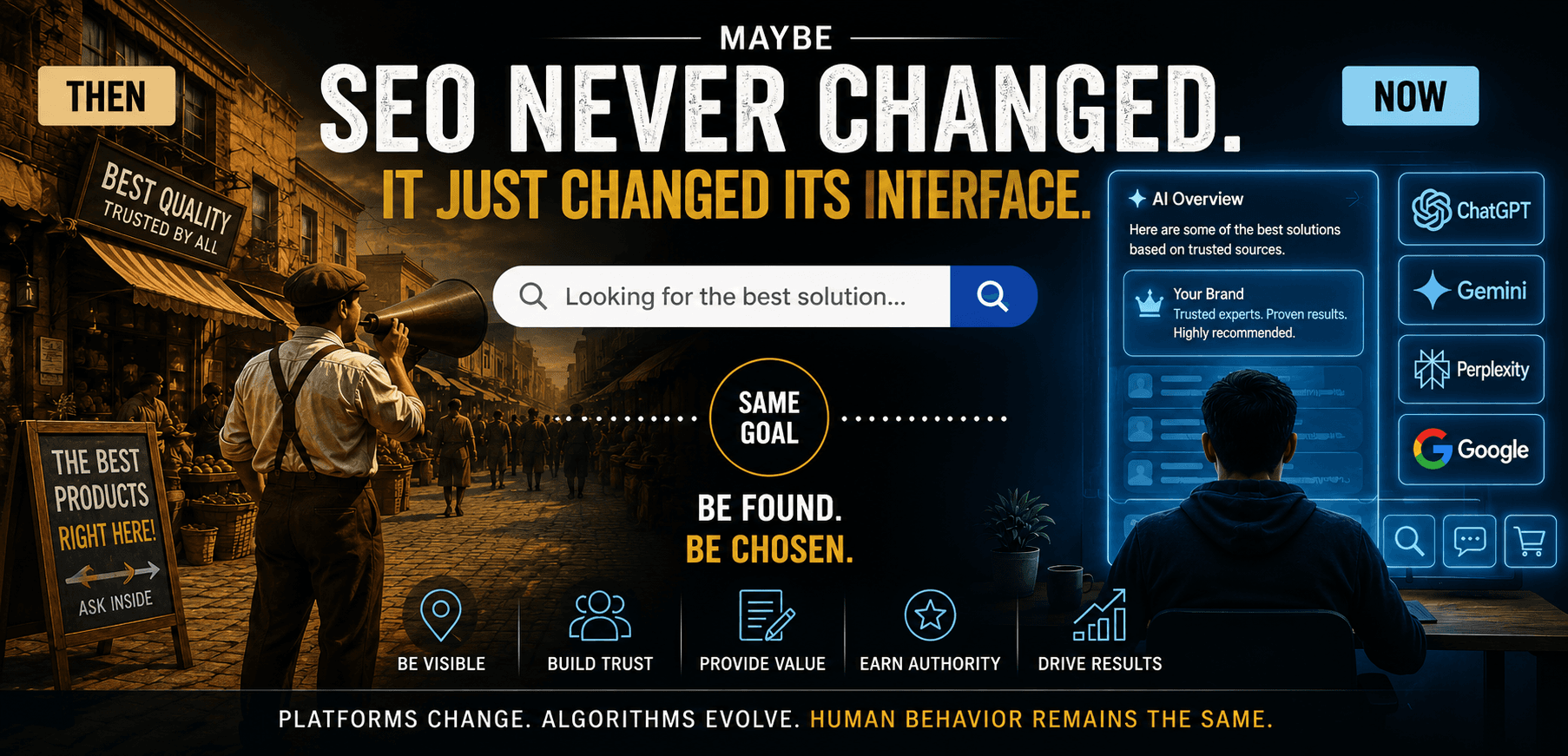
Maybe SEO Never Changed. It Just Changed Its Interface.
"People don't search because Google exists. Google exists because people search."
There was a time when every shopkeeper wanted the best location in the market.
The busiest street.
The shop at the main intersection.
The corner everyone had to walk past.
If your store stood there, customers naturally found you before they found your competitors.
No algorithms.
No keywords.
No backlinks.
Just visibility.
Back then, we called it prime business location.
Fast forward thirty years.
Businesses now fight for the first page of Google.
Now they're fighting to appear inside ChatGPT, Gemini, AI Overviews, Perplexity, Claude, and every other AI-powered search experience.
The industry has responded with a fresh dictionary of buzzwords.
AI SEO.
AEO.
GEO.
LLM Optimization.
Answer Engine Optimization.
The terminology changes every few years.
Watching the excitement unfold, one can't help but ask a simple question.
Have we really invented something entirely new?
Or have we simply taken one of the oldest business principles—
"Be where your customer is looking."
—and given it a modern interface?
The Search Engine Was Never the Point
Let's strip away the technology for a moment.
Forget Google.
Forget ChatGPT.
Forget AI.
Forget algorithms.
What remains?
A customer has a question.
A business has an answer.
The customer's journey hasn't changed for hundreds of years.
Yesterday, someone walked through a marketplace asking,
"Where can I buy good quality fabric?"
Today, someone types,
"Best fabric store near me."
Tomorrow, they'll ask ChatGPT,
"Recommend a reliable fabric supplier in Delhi."
The medium changes.
The behavior doesn't.
People are still searching.
Businesses are still trying to be discovered.
Only the interface has evolved.
Every Generation Thinks Search Has Changed Forever
Every few years, the industry announces the death of SEO.
We heard it when Google Ads became dominant.
We heard it when Facebook exploded.
We heard it when voice search arrived.
We heard it when Amazon became the default product search engine.
We heard it when TikTok became Gen Z's search engine.
Now we hear it because AI answers questions directly.
Yet every prediction missed one important fact.
People never stopped searching.
They simply searched somewhere else.
Search is not a Google feature.
It is human behavior.
SEO Was Never About Google
This may sound controversial, but SEO has never truly been about Google.
Google was simply the largest gateway to information.
Today, people discover businesses through dozens of platforms.
Google.
YouTube.
LinkedIn.
Reddit.
Instagram.
TikTok.
Amazon.
ChatGPT.
Gemini.
Perplexity.
Tomorrow there will be more.
The destination changes.
Discovery doesn't.
Businesses don't optimize for Google.
They optimize for visibility wherever customers make decisions.
New Acronyms. Same Objective.
Our industry loves creating new terminology.
Yesterday it was:
SEO
Local SEO
Technical SEO
Today it's:
GEO
AEO
AI SEO
LLMO
Tomorrow, there will undoubtedly be another acronym.
But the objective remains exactly the same.
Become the best answer before your competitor does.
Whether that answer appears on Google's first page or inside an AI-generated response is becoming less important than whether your brand is trusted enough to be mentioned at all.
AI Didn't Kill SEO. It Exposed Weak SEO.
Many businesses believe AI has made SEO obsolete.
The opposite is closer to reality.
AI has exposed years of content created only to satisfy search engines.
For years, websites published thousands of articles targeting keywords rather than solving problems.
Many pages existed because someone searched for a phrase—not because anyone had genuine expertise.
AI doesn't reward that approach.
If your article simply repeats information already available everywhere else, AI has no reason to send users to your website.
It can summarize that information itself.
That's why many websites are seeing declining organic traffic.
Not because SEO died.
Because commodity content lost its value.
Authority Is Replacing Optimization
For years, ranking was largely about optimization.
Today, recommendation is increasingly about authority.
AI systems look for signals that humans trust.
That trust is built through:
First-hand experience
Original research
Real customer stories
Expert insights
Useful tools
Genuine opinions
Consistent brand recognition
The websites gaining visibility aren't necessarily publishing the most content.
They're publishing the most valuable content.
There's an important difference.
The Real Job of SEO Has Changed
Historically, SEO teams optimized websites.
Today, they optimize knowledge.
Yesterday, success meant publishing another blog targeting another keyword.
Today, success means becoming the source AI systems choose to reference.
That requires businesses to think differently.
Instead of asking,
"Which keyword should we target?"
Ask,
"Which question can only we answer better than anyone else?"
That shift changes everything.
Rankings Were Never the Goal
Many businesses still obsess over rankings.
Rank #1.
Featured Snippet.
AI Overview.
ChatGPT mention.
But rankings have always been a means—not the destination.
The real objective has always been:
Visibility.
Trust.
Conversions.
Revenue.
Whether someone discovers your business through Google Search, an AI assistant, YouTube, or Reddit matters far less than whether they discover you before your competitors.
What SEO Looks Like in 2026 and Beyond
The future belongs to businesses that create information AI cannot easily replicate.
That means investing in:
Original industry research
Customer case studies
Proprietary data
Interactive tools and calculators
Video demonstrations
Community discussions
Expert-led content
Strong personal brands
Real customer reviews
Brand authority across multiple platforms
SEO is becoming less about optimizing pages and more about building a brand that deserves to be recommended.
The Businesses That Will Win
The next generation of winners won't be the companies publishing the highest number of blogs.
They'll be the companies becoming the most trusted source in their industry.
Because AI isn't replacing search.
It's replacing average answers.
The internet no longer rewards businesses that simply publish information.
It rewards businesses that create knowledge.
Final Thought
Every generation believes technology has reinvented marketing.
History usually tells a different story.
Yesterday, businesses competed for the busiest street.
Then they competed for Google's first page.
Today they're competing for AI recommendations.
The destination keeps changing.
The principle never does.
People have always searched.
Businesses have always wanted to be found.
Perhaps SEO never disappeared.
It simply changed its interface.
About the Author
At Yeti Digital Labs, we believe SEO is no longer about ranking pages—it's about becoming the most trusted answer across Google Search, AI Overviews, ChatGPT, Gemini, Perplexity, YouTube, Reddit, and every platform where customers seek information. The future belongs to brands that build authority, not just traffic.